
Qualcomm DIAG Mode is a special diagnostic mode available on Qualcomm Snapdragon processor powered smartphones. When the Qualcomm Diagnostic Mode is enabled on your phone, it opens the DIAG port that helps to write or repair IMEI number using tools like QPST Tool, QFIL Tool, and other tools. Lenovo Diagnostics for Windows (64-bit) About Lenovo + About Lenovo. Our Company News.
I have had many computers in my working space over the years. While some lasted long enough to be called dated, some just gave up too soon. Of all the problems, a dead USB port is the most common issue any Windows users may face. The dead USB Port problem is common with cheap Windows machines, but your outrageously expensive laptop is not immune to USB port failures either.
It happens that you connect a USB device into your computer and your computer refuses to detect the hardware. In such a situation, there are two possibilities. Either your USB device is faulty, or the computer’s USB port has a problem. If you are an in a similar situation right now, don’t panic and bash your laptop onto the wall, believe me, it won’t fix it. Here is a better way to diagnose and repair a dead USB port on your computer.
Diagnose the USB Device and USB Port

The first step to diagnosing a not working USB port is to make sure that it is the faulty USB Port and not the USB device you are trying to connect with problems.
Disconnect the USB device and connect it to another USB port on your Computer. If detected, your USB device has no problem. Now connect another USB device to the same USB port that did not detect the USB device earlier. If it remains undetected, then you have a faulty USB port.
A faulty USB port does not mean it is a hardware issue. Computers being electronic devices can have temporary glitches and problems that a quick restart can fix. It can also be a USB driver related problem which can be fixed with an update. So, before you go in full Louis Rossmann mode, let’s find out why the USB port is not working.
Restart Your PC to Fix the Not Working USB Port
As I said earlier, the USB Port not working problem may be a temporary glitch that can be fixed with a simple restart. At times, a single faulty USB port can shut down other USB port from detecting any devices.
All you have to do is shut down your computer and start it again. In case your computer doesn’t have a hardware issue, the USB ports should be working fine now.
Still not working? Restart your PC a few times more. As silly it may sound, your USB drivers may not be loading properly, but restarting your PC a few times can do the trick.
Disable USB Selective Suspend Option
Windows 10 and other versions of Windows including XP, Vista, 7, 8 and 8.1 comes with a USB Selective Suspend feature that allows you to automatically put USB devices in low power mode when they are in idle state. USB selective suspend process is particularly essential for a laptop for providing better battery optimization.
However, USB Selective Suspend can also create trouble and leave your USB ports in the non-functional state due to several reasons. In case all or one of the USB port is not working on your computer, you can try disabling USB selective suspend temporarily to fix the issue.
Follow these steps to disable USB selective Suspend in Windows 10
These steps also work with the older version of Windows including
Windows 7,8 and XP.
1. Open Control Panel. Right-click on Start and select Control Panel from the options.

2. Click System and Security and then click on Power Options.
3. Click Change Plan Settings.
4. Click on Change advanced power settings option.
5. Expand USB Settings and then expand USB Selective Suspend settings.
6. If the “USB Selective Suspend” option is enabled, click the drop-down menu and select Disabled.
7. For Laptop users, USB selective suspend option is available for both Battery and Plugged in, so make sure you change the options accordingly.
8. Click Apply to save the changes.
Now you need to restart your PC. Connect your USB device to the non-working USB port and see if disabling USB selective suspend fixed the issue.
Uninstall USB Host Controller Driver
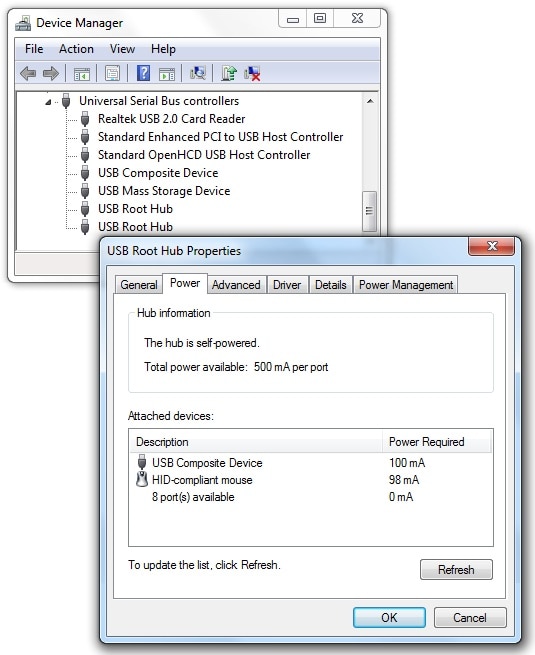
The next place to look when your USB device does not work is the device manager. Device Manager shows all the devices that are connected to your computer. To fix a dead USB port, we need to analyze Universal Series Bus controllers and associated drivers.
1. Open Device Manager by right-clicking on Start > Device Manager.
2. From the Device Manager, scroll down to Universal Serial Bus Controllers and expand it. We are looking for eXtensible Host Controller option.
3. If you don’t see the option, click on Scan for Hardware Changes option under Action. Device Manager will scan for any missing hardware and list it.
4. Right-click on eXtensible Host Controller and select Uninstall Device option.
You may also need to uninstall other USB devices listed in Device Manager Universal Serial Bus controller section.
If you have any unknown USB devices listed, uninstall them as well.
Once the Host Controller is uninstalled, restart the PC. Windows will reinstall the drivers as the PC restarts, and in the meantime, anything connected to the USB ports may stop responding until the drivers are reinstalled automatically.
Update USB Drivers
At times outdated drivers may create issues with a computer’s USB port. You most certainly have an obsolete driver if some of the USB devices don’t work with your PC instead of all.
To get the latest driver, visit your laptop manufacturer’s website and run the tools provided by the company that checks for the outdated drivers and suggests the best drivers compatible with your hardware. Install the hardware and restart the PC.
Perform a System Restore
If nothing seems working, you can try performing a System Restore. If you have created a System Restore Point earlier or have one created by default, you can restore your PC to earlier System Restore point.
System Restore if configured on your PC does not affect files and documents saved on your PC. But, any recently installed programs and drivers might get uninstalled. If you don’t have a restore point created, you may simply reset the PC by going to Settings > Recovery > Reset This PC.
Check the USB Ports for Hardware Failure
If none of those as mentioned earlier solutions above work then you may need to check your USB port for a hardware problem. If you are not comfortable opening the laptop or PC, take help of a professional or your friend who deals with computer hardware.
Clean Dust – Over time the USB ports start collecting dust which if not cleaned may create a problem and leave the USB ports non-functional. You can begin with checking if the USB ports are clean. If not, use a can of compressed air to clean the dust.
Remove and Connect USB Port Connection – If you can access the computer’s motherboard, you should be able to remove the USB patch cable from the motherboard and then reconnect it. Doing this may help you fix the issue. Then again, don’t do this if you don’t know what you are doing.
Computer Repair shops can be expensive at times. Make sure you take the computer to multiple shops as some may insist on replacing the entire motherboard to fix the dead USB ports which might be unnecessary at times. If you know how to use a soldering iron, you may watch some YouTube videos to fix it yourself.
Other Windows Tips
All USB ports are not working,( therefore, the mouse and the Keyboard can not work with dead USB ports) hence, it is impossible to apply the above methods without the mouse and keyboard.
This article show a guide on how to configure VCDS diagnostic cable for you laptop
Preparation:
Procedures:
Connect the USB end of your USB Interface or the Serial end of your Serial Interface to the correct port on your PC. If your PC is further from the vehicle’s diagnostic port than 6 feet,
connect an approved Extension Cable between the PC and the Interface.
If you are using a Serial Interface then you can proceed to step #4. If you are using a USB
Interface, a message like this should pop up:
The drivers many install automatically in Windows 7 or Vista. If you are using XP or W2000, click on the Found New Hardware message and the Found New Hardware Wizard should start up. If you are prompted with the choice, pick “No, Not This Time” when asked if you want to connect to the Internet to search for drivers. Select “Install the software automatically (Recommended)” then click [Next >]
The process should be automated but you may need to click “Continue Anyway” part way through the process.
If, for some reason, you installed the USB Interface without following the above instructions, and VCDS does not work correctly, go into your PC’s Device Manager while the USB Interface is connected.
You can find the Device Manager by right-clicking on My Computer in XP or on Computer in Vista or 7. Select Manage to bring up Computer Management. On the left side of the screen under System Tools, select Device Manager.
Find the “VCDS Compatible USB Interface” or similar and delete it. It may be under “Other Devices” or under “Universal Serial Bus Controllers”. Next, unplug the USB Interface from your PC, wait 5 seconds and plug it back in.
Connect the car end of your Interface to your vehicle’s Diagnostic Port.
If your vehicle has a 2×2 port (some pre-1996 vehicles), then use the optional 2×2 Adapter between the Interface and the ports in the car. This is included in the Pro-Kit.
Turn the vehicle’s ignition switch to the ON position. Make sure the key is turned far enough that the dash lights are fully illuminated. The engine may either be running or stopped.
Start the VCDS program on your PC through either the Start Menu or the VCDS icon on your Desktop.
From the Main Screen in VCDS click the [Options] button to go into the Options screen.
Once you are in the Options Screen,Select the correct port for your PC’s USB Port (USB) or Serial Port (typically COM1 or COM2) and click the [Test] button. Ensure that VCDS finds your interface.
Advanced Diagnostics Usa
You should see a message like this:
If the Interface Status is “Not Found!”,check the connections at the car and PC.Make sure both are plugged in securely.Serial Interfaces get their power from the vehicle so they will not be recognized at all if not plugged into a car.
Adapter Type should always be “RossTech” followed by the name of the Interface such as “HEX-USB+CAN”.
Version indicates the firmware version of your Interface. It may be updated by new versions of VCDS, if so follow the prompts on the screen.
Once you have tested successfully, click [OK] then click [Save] to apply this configuration,you will be returned to the Main Screen. Click on [Select] to view the Select Control Module Screen. Select one of your car’s Control Modules such as Engine.
Note: Your car will not have all the Control Modules listed in VCDS, only the functional ones that were installed in your vehicle.
After VCDS has connected, click on [Fault Codes] to check for Fault Codes (DTCs).Repeat the process for each of your car’s Control Modules.
Drivers Advanced Diagnostics Port Devices Inc
Readers who read this article also read: